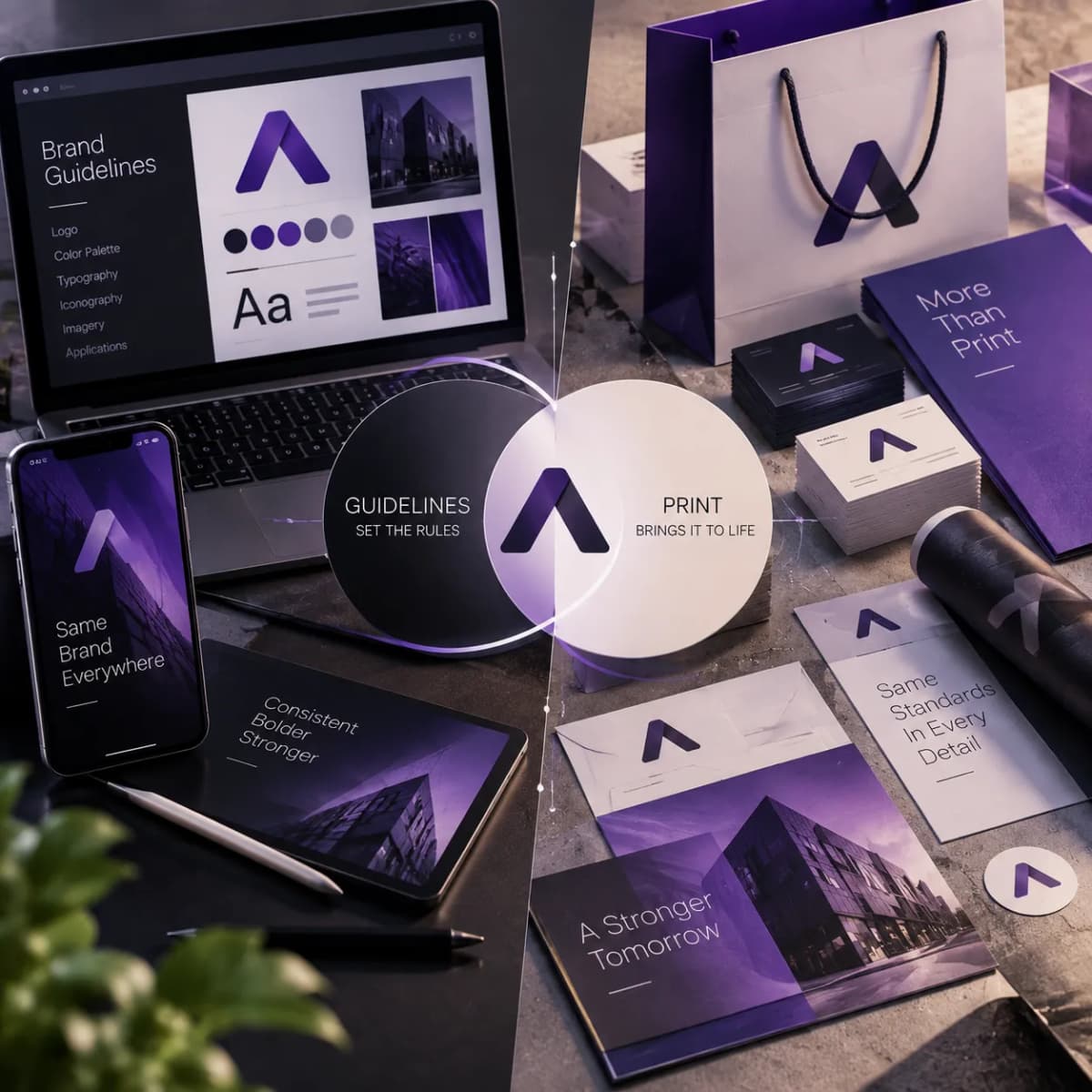
Because they are two faces of the same coin of consistency: the guide sets the rules, and print is where those rules get broken most in practice.
When one house documents your identity and executes your prints, it guarantees that the paper reaching your client's hand matches the screen they first saw it on:
And when your need in either path grows, we simply separate it into a standalone service.
Why it looks the way it does — understanding the "why" protects the "how".
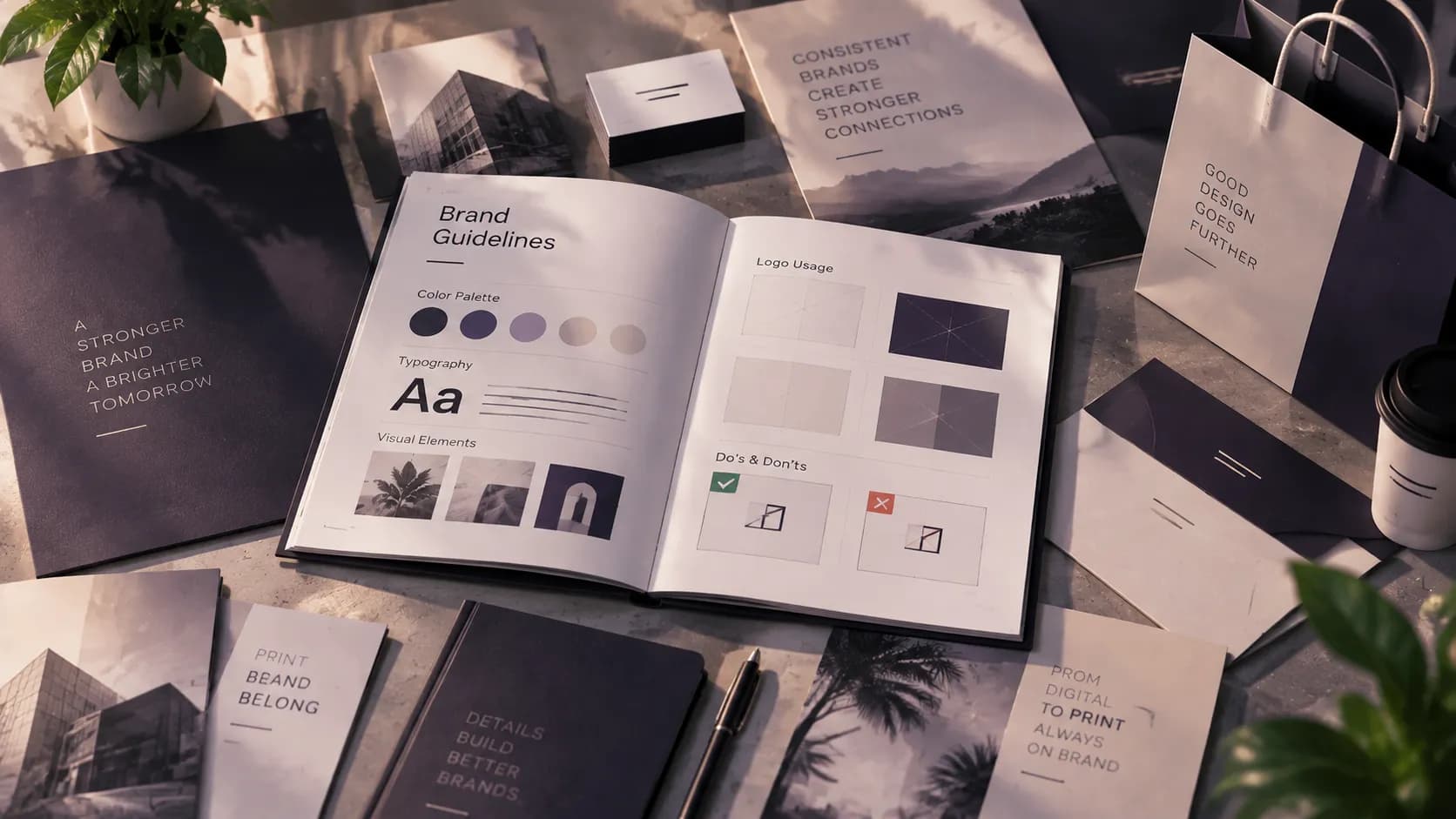
Approved versions, clear space, minimum sizes, and prohibited uses (Do's & Don'ts) illustrated with examples.
Exact values for each medium (RGB for screens, CMYK for print, HEX for web) and the rules for combining them and their proportions.
The approved Arabic and English fonts, sizes, weights, and spacing, plus the permitted fallbacks when a font is unavailable.
Patterns, icons, layout grids, and the photography style.
Designed examples for the key touchpoints — a card, a post, a presentation, a storefront — as a reference any future implementer can follow.
The guide is not a luxury — it is insurance for your identity.
If your in-house team designs, or you deal with more than one vendor (a print shop here, a freelance designer there, a third ad agency), or you are planning a franchise or new branches.
And if you are at an earlier stage, we deliver the guidelines summary with the identity — enough until the need for a comprehensive guide matures.
Business cards, letterheads, envelopes, folders, stamps, and ID cards — the small details that make up the professional impression in every meeting and signature.
The company profile is your ambassador in meetings you don't attend: we design it with a considered content structure — story, services, numbers, works — and deliver it in two versions: a luxurious printed edition for boardrooms, and an interactive PDF for sending. Brochures and flyers for campaigns and exhibitions follow the same standards.
Designing product packaging, bags, and boxes — where the identity meets the product in the customer's hand. We design with respect for actual production specifications and the regulatory labeling requirements of the Saudi market.
Storefront and office signage, exhibition booths, roll-ups, and banners — designs that read from their correct distance and are produced at the sizes and file resolutions that guarantee large-format print quality.
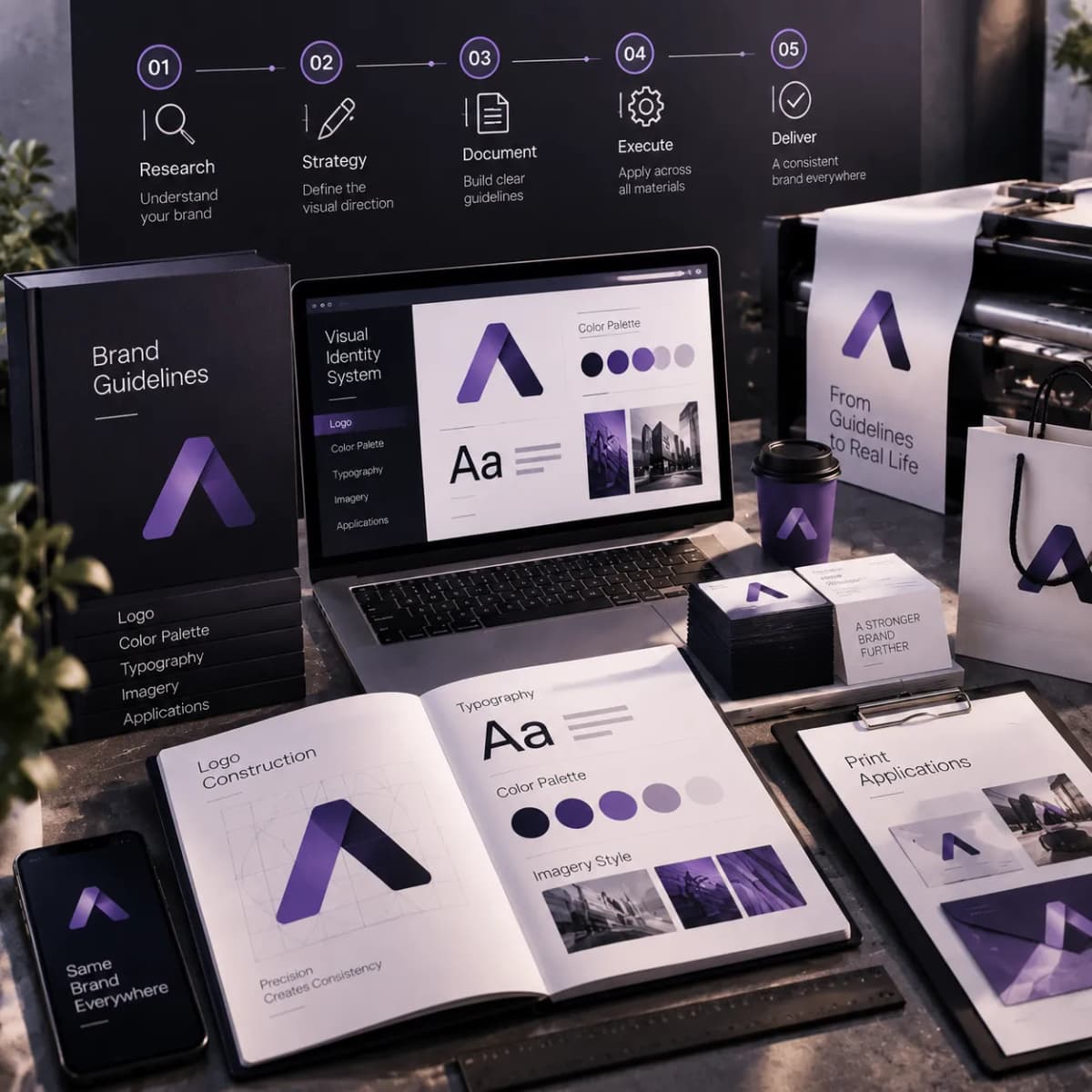
We review your current identity and existing printed assets, and identify the gaps and priorities.
Building the guide or designing the required prints with precise production specifications (sizes, resolution, CMYK colors, and bleed margins).
Print-ready PDF files + recommended paper and material guidelines — and we follow up technically with your print shop when needed, until the paper comes out exactly as designed.

The guide needs a system to document: if you only have a logo, we start by developing the missing elements (colors, fonts, patterns) and then document them — which is covered by the Full Visual Identity Design service before the guide.
A good guide isn't measured by page count but by the clarity of its rules: our guides typically run between 30 and 80 pages depending on the identity's size and the number of documented applications.
It follows the page count, whether the copy is ready on your side or we write it with you, and the number of copies (printed/digital). Send us an overview of your company and we'll return a detailed quote.
Our specialty is design with complete production specifications, and we follow up technically with the print shop you choose (or we can recommend printers whose quality we know) until the printed piece matches the design.
For the guide: an interactive PDF + updatable source files. For prints: print-ready files with CMYK specifications and bleed margins + digital copies for sharing.
Yes — it's a common request: we review the available files, technically complete what's missing, then document the entire system in one reference guide.